 |
| Middle East |
Middle East
This Spring (2010) I had the opportunity to attend an intensive course at Hebrew University in Jerusalem on Conflict Resolution and the Arab-Israeli Conflict. Originally I was ineligible to attend as my home department is Geography, not Political Science. Then my friend Hallie, who is in Economics, pushed and prodded her way in and, luckily for me, two spots ended up opening up. I was able to get one of the spots and suddenly I was travelling to the Israel in a couple weeks. The news came as I was furiously writing my term papers and studying for exams so I didn’t have much time to think of travel plans or do any research. Instead, I just attached myself to a group of friends who had already planned a one week trip to Egypt before the course and a week-long trip to Jordan and Syria afterwards.
Egypt
My travels started as all good vacations do: I was met at the airport by friends and we proceeded to stock up at the duty free on all the drinks the Egyptian government would allow us to buy. I mean this literally as there is a quota and they write down how much you buy in your passport. Alcohol is not illegal in Egypt, but it is difficult to purchase and expensive. So we had to stock up for the week, especially as we were going to spend much of the time on the beach.
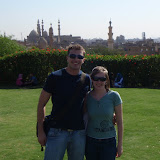
Steve, Martha, Emily, Shannon and I were staying at Martha’s friend Emily’s house. Emily teaches at a school in Cairo and has been living there for 3 long years so she and her boyfriend Tarek made for good guides. Once everyone’s flights arrived we proceeded to taxi downtown to a nice park to take in the view of Cairo and have lunch. Afterwards, we went to the Nile to go on a Faluka ride (sailboat) and then went to the market where we explored an old mosque. The Nile was not as big as I thought it would be, though rivers never are. The interesting thing about the Falkuka ride was learning that foreigners can do whatever they want in Egypt if they bribe the cops: fellow passengers were telling the story of how they had climbed the Great Pyramid and just bribed the cops to get away with it. I am not going to lie, I was a bit jealous of them, but I don’t have the balls to break a law so flagrantly.
That being said, when we were in the market we went to an old mosque and one of the custodians took us up to the top of the minaret and this may have been in a legal grey zone. But it was no pyramid, even though we did get a really nice view of old Cairo at night.
Given that this was my first day in Cairo I was left with a number of lingering impressions. I was actually expecting crazy traffic, but it wasn’t that bad- though it turned out that this was because it was a long weekend. But the city was extremely polluted: there was so much dust particles in the air that pictures with flash at night would be full of glare. Oh, and crossing the street was like playing frogger, but I kinda expected that.
Day 2 in Cairo was at the pyramids. We woke up fairly early then taxied over to Gaza. The pyramids were amazing. Some sites are smaller in real life than expected, but the pyramids were as immense as I imagined. And it was cheap!! I think it cost less than ten dollars for entry, including entry into one of the pyramids! It was especially crazy to look at how giant the stone blocks were and to think that they were moved by manpower thousands of years ago. What was especially cool was entering one of the pyramids! It was just a long shaft that went down then up and ended in an empty room but it was crazy to think of how old it was and how long it had been there... We also were able to lie down in the sarcophagus which was kinda cool.
We also went on a camel ride (uncomfortable and really tall) and saw the sphinx (also cool). Afterwards some of us headed to the Egyptian Museum. Of all the museums I have ever been to (and that’s a lot) I can confidently say that it was the most unique. This is mainly because it was absolutely crammed with artifacts. Unfortunately, the building is too small to contain them all. Shelves were overflowing with every square inch taken up with figurines, coins, statues and other pieces. Some of these were labelled, (with maybe an explanation typed up on a manual typewriter) but most of them just had a number. Pretty much every room was like that, even the sarcophagi were stacked on top of one another. The highlight was King Tut’s death mask. It was even more impressive than I had imagined. 14 pounds of gold!! The rest of our time in Cairo was spent at a nice dinner celebrating Martha’s birthday and a trip to the citadel. We also had an epic game of spoons were we managed to break a glass, a spoon and scrape Emily Scott’s back. Then it was off to Dahab on the Red Sea.
Dahab is a low key resort town known for its fantastic snorkelling and diving. We spend 4 nights there relaxing and taking it easy. We went snorkelling (I took some fantastic pictures of fish), had some good meals (there is a long boardwalk full of restaurants) and bought souvenirs (Shannon broke out her Chinese bartering skills). One of the nights we had a nice picnic on the beach to celebrate Martha’s birthday (again).
Another evening was spent climbing Mount Sinai at night so we could watch the sunrise from the summit. It was a biblical experience. Shannon and I accidently sat right on the edge of a cliff when it was dark out and only realized our mistake as it grew lighter. We also saw the burning bush and the golden calf from the bible.
Unfortunately, our relaxing time in Dahab had to come to an end and we had to head up to Israel to start our course. This process was made difficult by the convoluted interstate relations in the region. As we were visiting Syria, which has no relations with Israel, we could not have any Israeli stamps in our passport and what stamps we did had to have no strange gaps indicating a hidden stopover in “Occupied Palestine” (as Syria refers to Israel). This meant out trip involved a ferry ride from Egypt to Jordan, this would give us Egyptian exit and Jordanian entry stamps. We would then cross by land from Jordan to Israel (without getting our passports stamped) and then come back from Israel into Jordan (again without being stamped) at the end of the course before transiting to Syria. As a result, our passport stamps line up to say we spent about 2 weeks in Jordan, when we were only there for a total of 4 days.
We knew about this process going in so we had a plan. On paper it was a simple matter of taking a ferry then a bus rather than a direct bus from Dahab to the border crossing. But like all the best laid plans our swiftly unravelled in the face of events. The ferry (or ferryboat for the readers from Kansas ;-) ) was ridiculously late. We expected it to be a couple hours late (we were in Egypt after all ) but we arrived at the terminal at 10 and did not board the boat till after four. Then we waited on the boat till 6 while they fed all the tour groups food (for some reason this could not be done while moving) and only got going at 6:30. This meant that there was no way we could get through customs between Jordan and Israel before it closed and would have to stay in Aqaba, Jordan. We had a list of hotels, but we didn’t take account of it being the weekend and almost all of them were booked. In the end four of us crammed into a small room with 2 single beds and 2 mattresses on the floor. I actually didn’t think it was that bad, but the girls tell me I am wrong and it was “absolutely disgusting”.
Day 2 of trying to get to Jerusalem started early as we had heard horror stories of the difficulties in getting into Israel. We had no problems, even with Syrian visas in our passports, we just asked nicely for them to stamp a separate sheet and were on our way. After a short, overpriced taxi ride from the border to the bus station we were ready to go to Jerusalem. However, our plans ran into another roadblock called Shabat. We had been told that Israel shuts down from sundown Friday to sundown Saturday. But we didn’t really understand it. We had to wait till 4:30 to catch a bus to Jerusalem as most busses don’t run on the Jewish holy day.
This could have really sucked (well it did a bit as we were all pretty tired) but we ended up running into Gilleen who was also making her way up from Cairo to Jerusalem. (small world eh?) We also found a beach so got to relax a bit.
Israel
I am going to resist the temptation to go through my trip in Israel chronologically- mostly because I forget the order of events, but also because that’s a bit boring for me to write. Instead, I will focus on my main impressions and thoughts.
We spent around three hours every day in the classroom but there were also a lot of field trips where we would travel to different parts of the country. So we were able to go up north to the Sea of Galilee, the Golan Heights and the Lebanese border, as well as tour around Jerusalem’s borders and parts of Tel Aviv. And since we were in Jerusalem there was a lot to see on an afternoon off.
I still haven’t quite digested my feelings about the Middle East and the whole experience there. I had managed to avoid engaging with the Arab-Israeli and Israeli-Palestinian conflicts for most of my academic studies. As a result, I entered into the course with a relatively open mind. Obviously, it is impossible to be ignorant of such an important international issue, but I had not spent years studying and engaging with it like some of my colleagues. This meant that I was, and still am, ignorant of many of the important dates, resolutions, conflicts, and issues that are intricate to the debate. That ignorance was bliss.
The professor was one of the best I have ever had and did an excellent job of going through different theories and models of conflict resolution and management, but he always brought it back to the conflict as a way to historically ground it. This meant we learnt a lot that could be applied to different conflicts, at the same time that we learnt about the Arab-Israeli conflict in particular. Yet it was only a two week course meaning many issues were only briefly touched upon.
I think the largest impression I have been left with is confusion and frustration. Confused because there is so much going on: Israel, Egypt, Jordan, Syria, Lebanon, the PA, Hamas, Hezbollah, Iran, the USA, settlers, Zionists, terrorists, political parties, religion, UN resolutions, international law, and so much history that it makes my eyes pop.
Then, once one begins to get the players straight and explore the issues and positions it becomes even more mind boggling. And as an outsider from a history-poor country I find it extremely difficult to wrap my head around some of the explanations and justifications for various policies. For example, the settlement movement to me makes zero sense. Yes, around two thousand years ago those hills were part of ancient Israel. But that was then. Today the settlements are one of the largest barriers to any peaceful resolution to the conflict. Of course, that’s part of the point of the settlements: to put facts on the ground. But the reason they want to put these facts on the ground is to reconstruct a country that was destroyed after it rebelled against Rome. To me, it seems ridiculous.
The same thing goes with the persistent and idiotic refusal to recognize Israel’s existence as a state. I understand the argument that was made 60-some years ago by the Arab/Palestinian side. The argument goes along the lines that the early Zionist settlement movements into the British mandate was illegal colonization of Palestinian land and the UN Partition Plan was a bunch of Europeans assuaging their guilt over the holocaust by giving Arab land to Israelis. This narrative does make those events seem fundamentally unfair, (though really, that pretty sums up all the borders made by Europeans during colonialism). But that was then. The fact is that the Israeli state is not going to go away and attempts to do so are inherently counterproductive to any efforts to create a viable Palestinian state, which is their ultimate goal.
Of course, this isn’t news and many of those who say they should push Israel into the sea (im thinking of you Ahmedinejad) know that it is counterproductive and not going to happen, but they just make use of the Palestinian issue for domestic consumption.
Clearly, the entire issue is complicated. Everyone knows it. Hell, the random Israeli who student talked to us for about 40 minutes about the conflict and who used the words ‘kill them all’ an uncomfortable amount of times even emphasized how ridiculously complicated it is. But whenever you read anything in a paper or, god forbid, the comment section on a webpage everyone acts like its black and white. Its either “Israel is the only democracy in the region, its neighbours wants to destroy it and they are under constant threat from terrorists. full stop” or “the West Bank and Gaza are under an illegal occupation by the IDF, Palestinians have no rights, no state and to this day their land is being slowly taken away by illegal settlements”. Both statements are true, but they leave no room for nuance or discussion about how to deal with the conflict.
And that’s the most frustrating thing about it. I don’t think anyone actually wants to resolve it. Sure, they would like for there to be peace, but within Israel there is no domestic appetite to make the concessions that would allow for a peace agreement (ie moving some of the Settlements and risking civil unrest with the far right). Palestinians face similar issues in dealing with their extremists who still argue for Mandate Palestine. And the Arab (and Iranian) neighbours don’t really seem to want peace either as the entire debacle is used to distract their population from how authoritarian and incompetent their governments are.
Now, I am being a bit hypocritical as I just made a couple giant overarching statements, right after I criticized ‘them’ for being too black and white. But that’s the impression I got after my extremely short time travelling and studying this issue. (that is also an important caveat: I was there for a two week course, and travelled two more weeks. So my observations and should be taken with a couple tablespoons of salt.) Basically, the entire issue is not likely to be solved anytime soon, seems to be getting worse day by day and I thank my lucky stars I live in Canada.
*update* I found an article by Margret Attwood that sums up my feelings here.
On a purely aesthetic/tourist level I thought Israel was wonderful. Arriving in Eilat from Jordan on that first day was a breath of fresh air. People were partying on the beach, there were bikinis and mixed-sex crowd! And we could cross the street so easily.
Jerusalem itself was also a very interesting city. It had a very conservative, religious vibe, which makes sense. But walking around the old city and seeing all those buildings, shrines and walls that people have been fighting over for thousands of years was intense.
During the course we went on a field trip up to the Golan Heights and the Sea of Galilee. What really stuck in my mind is how small Israel is. We went by the Jordan River and its little more than a stream. The Sea of Galilee would be a medium sized lake. And the Golan Heights themselves are just a small spit of land (though they are actually high, so that was satisfying).
We also went to Tel Aviv. It has an entirely different vibe than Jerusalem, a lot younger and more vibrant. We went out and partied and then spent the next day lying on the beach. It was very liveable.
West Bank
While furiously figuring out how to get from Jerusalem to Petra while seeing the dead sea and the West Bank, during Shabat, we realized such an itinerary was impossible as the buses stopped running. (Shabat was our nemesis in Jerusalem) So Shannon, Martha and I ended up doing a lightning trip to the West Bank after our last class. We took a taxi to the Wall and went through the checkpoint to Bethlehem and then took a taxi to Ramallah to check it out before bussing back to Jerusalem.
Crossing into the West Bank was an eerie experience. You go through a warehouse like structure and show your passports to Israeli guards. Then pass through a long connecting tunnel running parallel to the wall. Once out it becomes clear that you are out of Israel: the din, the language, the graffiti on the wall. It hits you that you are in a new country (not technically of course, but just go with it).
Bethlehem was fairly touristy. The church was interesting though nothing special. It was only notable in that they made sure I had my knees covered in addition to making sure the girls were conservatively dressed.
The taxi ride to Ramallah was interesting as we got to see the WB countryside, get a very vague idea how people live and see the settlements from afar (they are huge!). Given how much the West Bank is in the news it is difficult to not have some sort of pre-formed opinion. I knew that it was not going to be some post-apocalyptic war zone. But that ignorant part of my brain could not helped but be surprised by how many apartment buildings, nice cars (some new BMWs) and economic activity I saw. Of course there a lot more poor buildings, old cars and poverty, but its always interesting to see the juxtaposition.
Incidentally, its these moments that I enjoy most when travelling. Its always fun to see the famous sites and do the touristy stuff. But I love looking out the window and seeing the land, the buildings and all the other locations that you never really see on the news or in pictures. Reading a report or looking up statistics might give you the knowledge, but without seeing something its hard to wrap your head around such details.
Anyway, so we were in Ramallah. We had some food in a cafe run by a Palestinian guy with an Alabama accent. (which was random) We then checked our Yasser Arafat’s tomb by the PA and afterwards got directions to a local bar to try some Palestine beer. All in all a very satisfying day.
Jordan
The main reason we travelled to Jordan was to visit Petra. Ever since I watched Indiana Jones and the Last Crusade I have always wanted to visit Petra. To get there we bartered a taxi from the border with Israel to Wadi Musa, the town located on the edge of the ruins.
We spent about a day and a half in Petra. The first day we woke up early so that we could beat the crowds (and the heat). You buy your tickets on the edge of the site and then walk down the Suq for about 2km. Slowly the valley around you turns into a steep canyon which one walks down and because of the twists and turns you can almost trick yourself into thinking you are alone. Then suddenly the canyon ends and you see this massive stone structure (actually a tomb) carved out of the rock at the end of the route. It is a ‘wow’ moment if there ever was one. And what is crazy is that there are hundreds of these tombs! As you continue on into the city proper you continue to pass them by, as well as an amphitheatre carved out of the rock, until one reaches a broad avenue that passes old temples and under a Roman gate.
However, we opted to take a different route. Instead of heading down the avenue with everyone else we decided to hike up a side canyon to the “High Place of Sacrafice”. After a fun hike up hundreds of steps we had a beautiful view of the entire area. You could easily tell it used to be a fairly large city. There were tombs carved into cliff faces and hills throughout the valley and you could also identify ruins of buildings and see where the old irrigation systems used to collect and store the water. One could even see an old Egyptian Obelisk and a Crusader Castle. (again this region has too much history!)
So after a morning of hiking around the back-paths of Petra we wandered back down to the main touristy spot and took an hour breather in the shade to relax and rehydrate. We expected it to be hot and our expectations were certainly met. Although, it turned out that it was actually a heat wave in Jordan while we were there and the temperature in Petra was probably around 45C! But I gathered that was not typical. After our breather we walked up to a site called the Monastery. It is a bit off from the other sites in Petra. One has to hike about 45 km up a gulley to get there. Once you arrive it is pretty spectacular. It is much larger than many of the other tombs and much better preserved.
Day 2 was only a half day as we had to bus to Amman in the afternoon. Matt, Hallie and I hiked up behind some tombs to get a view of the Treasury and from above. This ended up being a bit of an adventure as we lost the path and pretty much just strait up the side of a cliff (practically). Which ws pretty exhausting in the heat, but it was worth it. Once there we found the path, which ended at a ledge from which you could sit and see the suq bottom and all the people entering Petra. The way down ended up being a lot easier as I found the steps. I also explored a bit of the old temple and the ruins of an old byzantine church.
I would have to say Petra was one of, if not the, highlights of my trip. Unfortunately, it is hard to describe and pictures don’t really do it justice either. It was just that it was historical as well as awe inspiring AND you were outside so you could go hiking. It wasn’t just seeing some church or mosque and elbowing your way past hundreds of other tourists. There was space to breath and enough hiking paths you could explore on your own.
From here we took the hottest bus ride of my life up to Amman. Like I said, it was a heat wave and there was no AC in the minibus. With the windows open it was like a blow drier on your face and with them closed it was equally hot. I survived though.
Amman was nice. There was a nice strip with lots of cafes and restaurants and the traffic was not too crazy. The only problem was our hotel was a bit sketchy. About three dollars a night but we got what we paid for as it had cockroaches and no AC.
Mike and Hallie had to catch a flight from Amman to the Sinai the next morning but Shannon, Martha and I went to the Dead Sea. We actually went to a nature preserve that does ecotourism and did a really cool trip where we hiked up a stream to a waterfall. We had to climb up through mini-rapids using ropes in a crazy gorge that the stream had carved into the sandstone. It was a great way to cool down.
The Dead Sea itself was worth checking out but not for too long. It was nice to finally be able to float (you couldn’t sink if you tried!!) but the water was so salty it burnt where i had a sunburn. And when you got out you could feel grains of salt everywhere. It felt crazy as well, almost thick and oily.
Lebanon
We flew into Beirut from Amman somewhat unprepared. Lebanon was a last minute addition to our trip as we began to think about how close we were to the Paris of the Middle East. This meant that we had pretty flexible travel plans in Lebanon. We were flying in, had a place to stay for two nights and knew that we would be bussing to Syria. But that was all we knew.
So when we arrived at the airport we had no idea about buses or money. Luckily, we had our handy Lonely Planet which informed us that the exchange rate was around 1500LL to 1USD and that if you walked strait you could eventually find a bus downtown. Turns out the book was right about the exchange rate (though I did end up getting a 100 000 LL bill, which is such a pain in the ass. dealing with exchange rates is a pain in general, but breaking large bills with so many zeros makes it even more frustrating), but the book was incorrect about the bus. We kept asking for directions in broken French, but they directed us to “go strait till you reach the Lebanese army, then turn left”. We decided to not wander into a military base looking for a bus and instead just took a taxi.
We had booked a hostel and so we luckily had a destination. But when we arrived to our hostel it turned out our reservation was more of a suggestion. And there was no room. The guy was super nice and suggested we could sleep on the roof. Except the roof looked like it had just been bombed. And in all fairness, it may have been. Luckily the people there were super nice and directed us to a nearby hostel that was insanely clean and we were able to get dorms.
Now Beirut is a unique city. Walking through it one could still see scars from the war, but these were side by side with crazy designer shops and luxury hotels. Of course we were in the downtown area, but it was still quite the contrast. And the price!! It was more than Toronto for many things (drinks 10USD for example!!) which was quite the sticker shock....
We nevertheless had a lot of fun. Trying to go to clubs (we weren’t well dressed enough to get in) and lying on the beach. In fact, it was so relaxing we ended up staying an extra night.
OH! And we met up with Emily from Egypt in Lebanon which was nice as she got to have a break from Cairo.
Syria
Travelling to Damascus from Beirut was simply a matter of getting into a shared taxi at the bus station and getting our passports stamped at customs.
Damascus itself was a surprisingly clean and well organized city. I say surprising as I was using Cairo as a base mark. Emily, who had lived there before, told us that this was fairly new. Apparently they are putting lots of money into new trees, buses and enforcing traffic rules. They also banned smoking inside restaurants, and people are obeying the law!! I guess there is something to be said about living in a police state. The old city was large and sprawling with crazy alleyways and new buildings beside ones that were clearly ancient. There was long market full of everything one could buy, as usual. The Umayyad Mosque was really nice. The problem with Mosques though is that they are designed to be places of prayer (duh). But this means that they are fairly simply decorated. So there are not hundreds of carvings or alcoves or gold plated statues to look at. It’s more aesthetically simple and (perhaps) pleasing, but not as fun to wander around in.
Given that we had been travelling for a month we were pretty lazy in Damascus. We just wandered around the old city a bit and then took it easy in the hostel. The next day we did a day trip to an old crusader castle called Krak de Chavalier. I love castles so I really enjoyed wandering around it, even if getting there was a bit of a pain. In Syria Palmyrra and Aleppo are the other big tourist attractions but we didn’t have time go there. Palmyrra is one of the ‘dead cities’ in the desert where you can wander around the old ruins. But given that we had just come from Petra we weren’t too disappointed we could not go. Aleppo supposedly is a city where one goes back in time, its full of market stalls and has a giant citadel on top of the hill. But I hate markets so I was not at all disappointed to skip various people trying to sell me overpriced perfumes and spices. Anyway, those are places we didn’t go.
One thing that I really liked about Syria was how green it was. It wasn’t lush or anything, and it was clearly semi-arid, but there was still grasslands and they had planted trees all along the side of the highway so it was almost like you were driving through a forest. The people were also very friendly. In fact, on the plane ride home a nice Syrian-American woman told me everything I needed to know about the government, the politics and the religious issues of the region. It was actually good advice: you have to be passionate about the region. Otherwise you will never be able to put in the effort to truly understand the issues.
I definitely do not have that passion. I am glad I had this opportunity to study the Middle East conflict and to travel around it a bid. But I do not have the drive, or to be honest the desire, to immerse myself in the issues, history and grievances that have built up over the years. And to be honest, that is probably a shame (and academically lazy of me). I bet that if people who did not have the same historical grievances and did not have such vested interests it would be easier to come to some peaceful solution....


